One of my favorite things in life is a high rising loaf of bread, so Cottage Cheese Bread makes me very happy! This is one of the highest rising and lightest textured loaves I’ve ever made. The recipe is not new. The original version is on Allrecipes.com where it is designed for a bread machine. Since I don’t have a bread machine, I converted it to a stand mixer recipe, made a few tiny adjustments and baked it in a loaf pan.
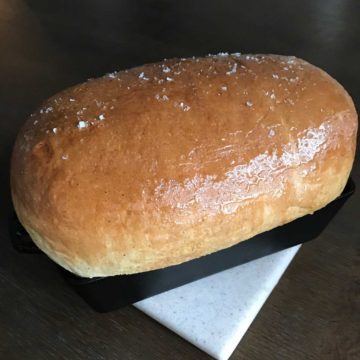
Here it is in a cast iron loaf pan, fresh out of the oven, after being brushed with honey and flaky sea salt. I was worried I wouldn’t be able to slice it since it rose so ridiculously high, but once cooled it sliced just fine. It was even easier to slice after being chilled, which is typical.
Here’s what the dough looked like before and after. Usually when my bread rises this high in the pan it doesn’t rise more in the oven. Not the case here. And it didn’t collapse, which I attribute to the cottage cheese (and its protein) providing some structure. Update: Turns out that’s only partially true because sour cream works in this bread too. I’ve added some notes to the recipe card on how to use sour cream in place of cottage cheese.
One of the old reviews described the texture as somewhat like angel food cake. I was a bit skeptical, but that person was right. The texture is a bit like angel food cake, but chewier and stable enough to hold sandwich fillings. It’s amazing for garlic toast!
Cottage Cheese Bread in a Pullman Loaf
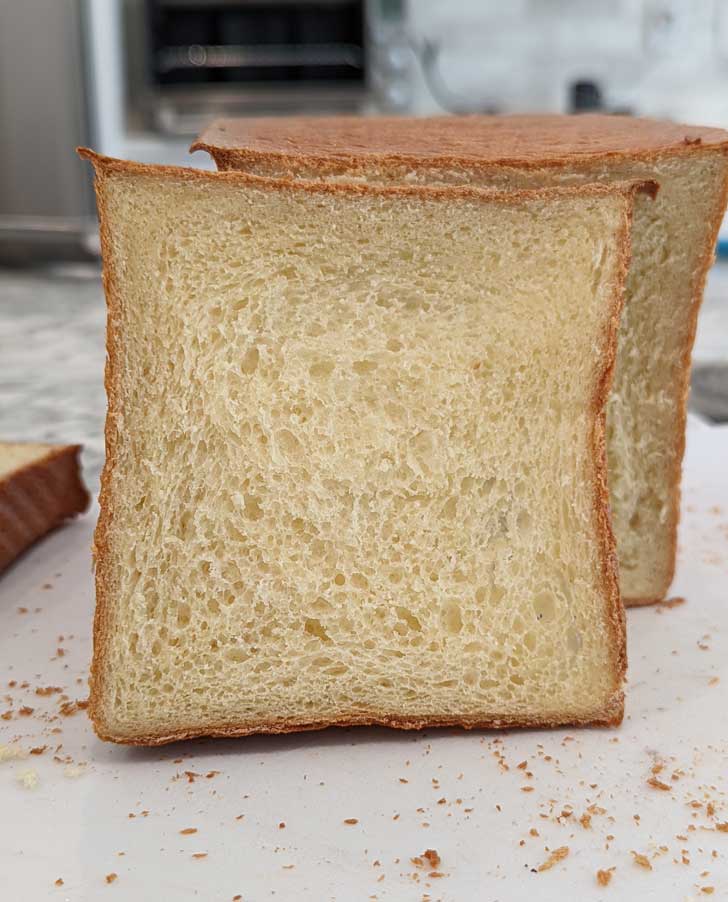
I finally tried making the bread in a Pullman loaf pan. I’ve been using my Pullman for a while because I love the high sides, but this was the first time I ever tried using the lid. I wasnt sure how much dough to use, so I took a chance and just squashed all 2 pounds of it in there pretty much knowing there’d be issues. The dough rose about ½ inch over, so when it was time to put the lid on and bake, I had to really squash it in there. Plus I’d left a little vent near the edge because I couldn’t quite get the lid to close, and a bit of the dough baked up and my loaf had a little tail coming out of it. But even still, it worked! I cut the tail right off.
How Much Dough in a Pullman?
If I had planned better I would have used the equation from Kneadrisebake.com to get the correct amount of dough. Chris and Carrie say that the correct amount of dough to use in a Pullman should be about 5 ½ times whatever the volume is of your Pullman pan in grams. So you first have to know the volume of your Pullman pan. To figure that out, you just multiply the pan’s DxWxH. You then multiply that number by 5, multiply it again by 6, then add the two numbers and divide by 2 to get the average. Updating to say the reason you multiple by 5 and by 6 rather than just saying 5.5 is you want to know the bottom end and the top end of the range.
Example. My Pullman pan measures 4″D x 7.6″W x 4.5″H so the volume is 137 cubic inches. 137×5=685 137×6=822. 685+822/2=753. So the “target” amount of dough should have been around 753 grams. I could have used as little as 685 or up to 822. I squished in a little under 900 grams which was just a tad too much. Next time when I make the cottage cheese bread I’ll discard some of the dough and use 753 grams, which is 27 ounces or about 1 pound 11 ounces.
Will this equation work for other types of dough? We’ll see! But the equations seems to work well in this cottage cheese bread recipe. I’ll have to give it a try with my basic white bread.
Gluten-Free Cottage Cheese Bread
I recently tested this recipe with the new King Arthur Gluten-Free Bread Flour. I made the mistake of just dumping in 400 grams of flour rather than adding gradually, so I ended up with a dry dough that needed more water. Apparently the new gluten-free bread flour absorbs moisture quicker than all-purpose. Despite that, I got a pretty nice loaf of gluten-free sandwich bread enriched with cottage cheese. I’m going to test it again with the new gluten-free bread flour, but use only 300 grams to start. Update: Made it again with gluten-free flour and it worked! It only needed between 250 and 300 grams.
Update: For anyone following the gluten-free cottage cheese bread trials, so far I’ve had the best luck using 300 grams gluten-free KA bread flour, ½ cup warm water, 2 teaspoons instant or active dry yeast, 4 teaspoons sugar, 1 teaspoon salt, ¼ teaspoon baking soda, 1 egg, 1 cup cottage cheese and 2 tablespoons softened butter. This give you a dough that’s thick enough to shape as you would normal bread. Put it in a loaf pan (preferably a Pullman), let it rise for about 1 hour in the loaf pan and bake at 350 for at least an hour. The loaf is not light and fluffy, but it doesn’t collapse in on itself.
More Recipes with Cottage Cheese
- Cottage Cheese Banana Bread
- Cottage Cheese Cookies
- Butter Crunch Lemon Cheese Bars
- Cottage Cheese Dinner Rolls
- Caraway Cottage Cheese Bread
- Gluten-Free Sorghum Bread
Recipe
Cottage Cheese Sandwich Bread
Anna
Pin Recipe
Ingredients
- ½ cup warm water (110-115 degrees)
- 2 teaspoons instant yeast
- 4 teaspoons sugar
- 3 ½ cups all-purpose flour, divided use (470 grams)
- ¼ teaspoon baking soda
- 1 teaspoon salt
- 1 cup cottage cheese, not too cold (microwave for 10 sec)
- 1 large egg, room temperature** (60 grams)
- 2 tablespoons olive oil or use half oil and half butter (28 grams)
Instructions
-
Put the ½ cup (114 grams) of warm water in a stand mixer bowl and add the yeast to proof. Add a teaspoon of the sugar. When you start seeing bubbles, add remaining sugar, ONLY 3 cups (400 grams) of the flour, baking soda and salt and stir to mix. Stir in the cottage cheese, egg and oil (or oil/butter combo). Use the paddle attachment of a stand mixer to blend.
-
Switch to the dough hook and begin kneading. It should be very sticky, so add another ¼ cup of flour. Continue to knead and scrape sides of bowl. Continue adding flour by tablespoons and kneading until dough climbs up the hook and doesn’t stick to the sides of the bowl. Dough will be a tiny bit sticky, but easy to handle with a little oil on your fingers. This is a very smooth but firm and not too airy or fluffy dough. It will rise, but it takes its time, so be patient.
-
Put a little extra olive oil in a large bowl.
-
Put the dough into the oily bowl and then turn so that the dough is coated with oil. Cover and let rise until it doubles in size. This should take at least an hour and maybe up to an hour and a half.
-
Punch down the dough and shape into a rectangle. Roll into a cylinder, pressing out air as you roll.
-
Pinch down the ends and put in a greased 8 ½ x 4 ½ inch loaf pan or a 9×5 inch loaf pan. Note: If you use the 8 ½ by 4 ½ inch pan, it will rise VERY high and be a little more awkward to cut. I kind of like the drama in that, so I use that size anyway. A 9×5 inch is more practical.
-
Cover loosely with some greased plastic wrap and let rise in a warm place until the dough domes about an inch (in the center) over the edge of the pan. This should take around 45 minutes.
-
Preheat oven to 400 degrees F. Put the loaf in the 400 degree oven, then close door and turn the heat down to 375F. Bake for 35 minutes. Remove from oven and brush hot loaf with honey and sprinkle top with a little sea salt.
-
Let cool in pan for about 20 minutes, then remove from pan and let cool completely.
Notes